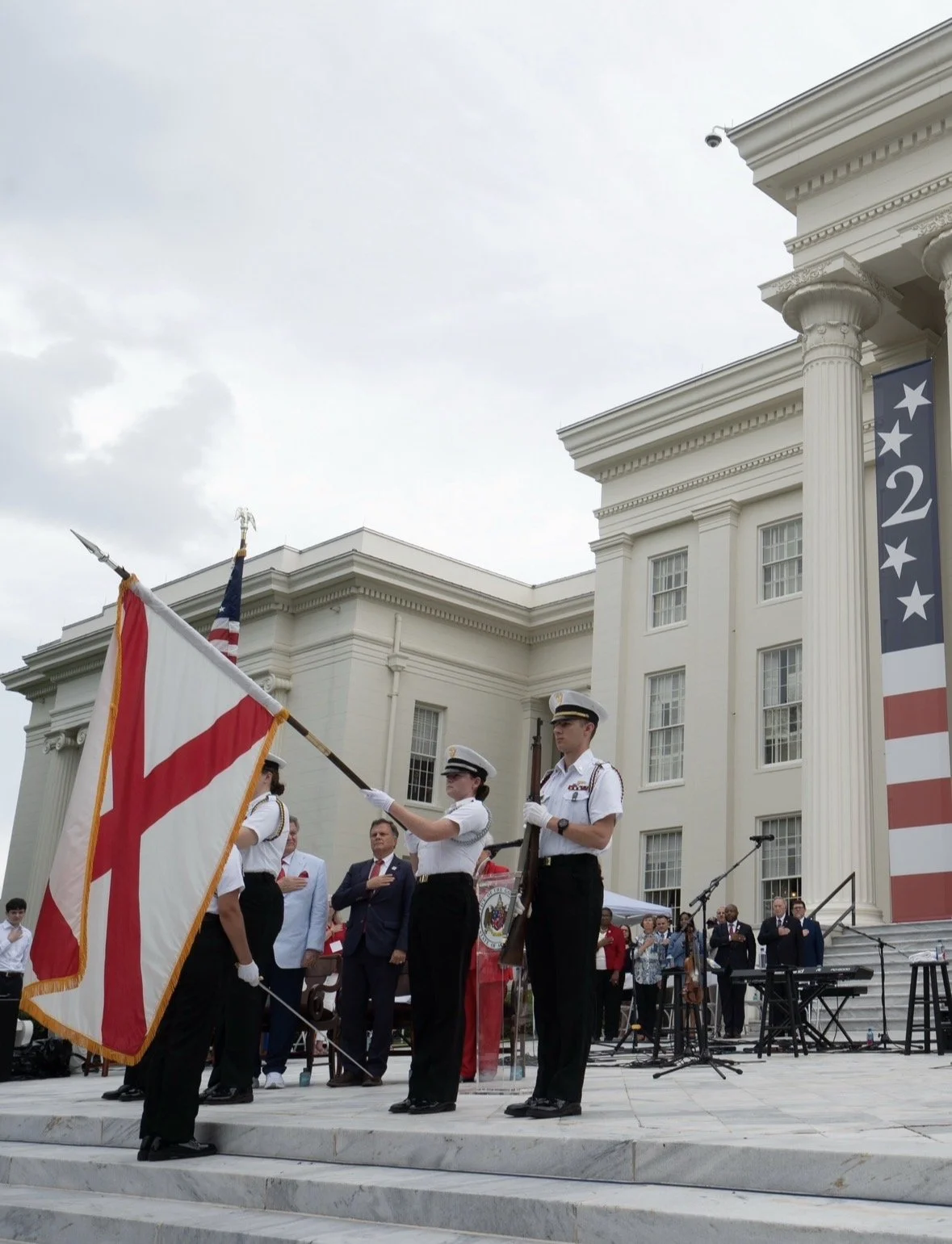
Alabama, Memory, and the American Story at 250
As the United States approaches the 250th anniversary of its founding in 2026, Americans are increasingly reflecting upon the people, places, institutions, and events that shaped the nation’s journey across two and a half centuries.
Few states occupy a more significant place in that story than Alabama.
Few cities occupy a more consequential place within Alabama than Montgomery.
For generations, Montgomery has stood at the crossroads of American history. From the growth of the early republic and the expansion of the frontier, through the Civil War, Reconstruction, the Civil Rights Movement, and into the modern era, the city has repeatedly served as a stage upon which the nation confronted defining questions of liberty, citizenship, justice, governance, and human dignity.
The Alabama State Capitol remains one of the most recognizable symbols of that history.
Standing beneath its dome, one can view not merely a government building but a witness to generations of American transformation. The Capitol grounds have seen moments of celebration, moments of conflict, moments of division, and moments of reconciliation. They remind us that the American story has never been static. It has always been a continual effort to align national ideals with national conduct.
As the nation prepares to commemorate its Semiquincentennial the 250th anniversary of the Declaration of Independence there is renewed value in preserving the places where history occurred and studying them honestly.
The McWhorter family’s connection to Montgomery extends across generations. Historic family property located near the Capitol district remains within one of Alabama’s most historically significant corridors. Situated only blocks from the Capitol and within the broader landscape connected to major civic and civil rights milestones, the property serves as a reminder that family history and national history are often intertwined.
Stewardship requires more than ownership.
It requires memory.
The responsibility of preservation is not to celebrate the past uncritically, nor to erase portions of history that make us uncomfortable. Rather, it is to preserve the historical record faithfully so future generations may understand both the achievements and failures that shaped the society they inherit.
The American story contains extraordinary examples of courage, faith, sacrifice, innovation, and perseverance. It also contains chapters marked by injustice, division, and human suffering. Both belong to the historical record.
Neither should be forgotten.
As America enters its 250th year, the question facing every generation is not whether history was perfect. It was not. The question is whether we possess the wisdom to learn from it.
The preservation of archives, historic properties, monuments, cultural institutions, and family records plays an essential role in that effort. They provide continuity between generations and help ensure that the lessons of the past remain accessible to the future.
At the McWhorter Foundation, we believe that true stewardship is measured not by what a generation inherits, but by what it preserves and passes forward.
The approaching 250th anniversary of the United States is not simply a celebration of age. It is an opportunity for reflection.
An opportunity to examine where we have succeeded.
An opportunity to acknowledge where we have fallen short.
And an opportunity to recommit ourselves to the enduring principles that continue to guide the American experiment.
For history is not merely about the past.
It is an inheritance entrusted to the living.
And the responsibility of every generation is to leave that inheritance stronger than it found it.