Henry McWhorter (1760–1848): Revolutionary War Veteran, Pioneer, and Builder of Community
Few family histories are defined by a single generation. Rather, they are shaped by ordinary men and women whose decisions quietly influence centuries that follow.
Among those remembered within the McWhorter family is Henry McWhorter (1760–1848) a Revolutionary War veteran, pioneer, mill builder, and respected community leader whose life reflected the resilience of America’s early frontier.
His story is not simply one of settlement, but of stewardship.
Service During the American Revolution
Born in Virginia in 1760, Henry McWhorter came of age during one of the most consequential periods in American history.
As a young man, he served in the American Revolutionary War, joining thousands who fought for the independence of the thirteen colonies. Historical records identify him as a Revolutionary War veteran, and his service formed part of a generation that helped establish the foundations of the United States.
While many veterans returned to familiar communities after the war, others looked westward toward the expanding American frontier.
Henry McWhorter chose the frontier.
A Pioneer of Northwestern Virginia
Following the Revolution, Henry journeyed into the wilderness of what was then western Virginia, eventually settling along Hacker’s Creek in present day Lewis County, West Virginia.
At the time, the region consisted largely of dense forests, rivers, and isolated settlements.
Frontier life demanded more than endurance.
It required vision.
The earliest settlers were expected to construct homes, cultivate farmland, establish commerce, and create the civic institutions necessary for an enduring community.
Henry became one of those builders.
The Cabin of 1793
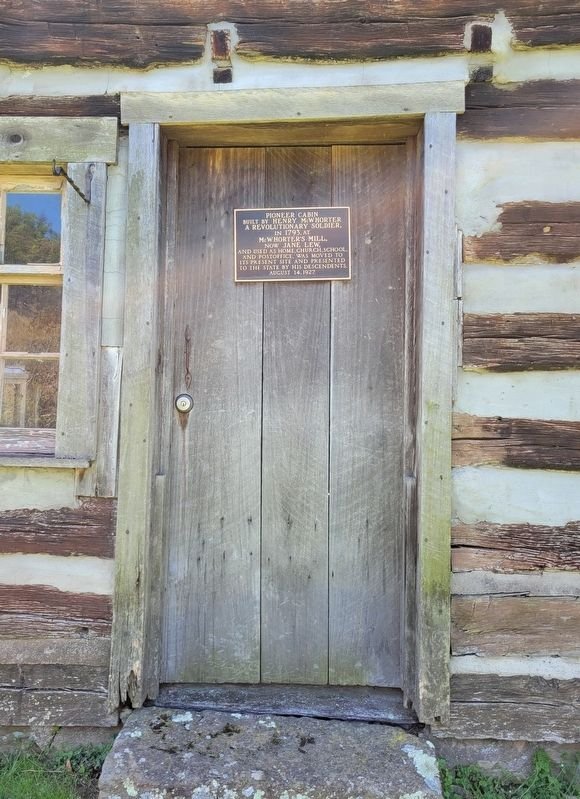
In 1793, Henry McWhorter constructed the log cabin that would become one of the most recognized pioneer structures in West Virginia history.
Built from hand-hewn timber using traditional frontier craftsmanship, the cabin represented far more than shelter.
For decades it served as one of the region’s most important gathering places.
Historical accounts record that the cabin functioned not only as the McWhorter family home but also as a:
Church
School
Community meeting house
Early post office
In an era before permanent public buildings existed across much of the frontier, a single home often became the civic heart of an entire settlement.
The McWhorter cabin was one such place.
Building the First Gristmill
Henry McWhorter understood that thriving communities required more than homes.
They required industry.
Around the time of establishing his homestead, he constructed what local histories describe as the first gristmill in the surrounding region.
The mill became essential to neighboring families, who traveled considerable distances to have grain processed into flour and meal.
One oft-repeated account describes a season of scarcity during which Henry declined opportunities to sell his flour at exceptionally high prices, choosing instead to ensure local families had access to food.
Whether viewed as business, public service, or simple charity, the story reflects values long associated with frontier communities: responsibility, fairness, and stewardship.
Stewardship Beyond Property
The legacy Henry McWhorter left was not measured solely by acreage or buildings.
His greatest contribution was helping establish a functioning community.
Church services were held beneath his roof.
Children received instruction.
Neighbors gathered to conduct civic affairs.
Travelers stopped to collect mail.
The mill supported agriculture.
His home supported people.
This combination of enterprise and public service distinguished many early American pioneers whose influence extended well beyond their own families.
Preservation for Future Generations
Unlike countless frontier structures lost to time, the Henry McWhorter cabin survived.
In the twentieth century, descendants carefully dismantled the original structure, preserving each log before reconstructing it at Jackson’s Mill State Historic Area in Lewis County, West Virginia.
Its preservation allows future generations to experience an authentic example of eighteenth century frontier architecture while remembering the individuals who helped establish the surrounding region.
Today, the cabin remains one of the oldest surviving landmarks connected to the McWhorter family.
An Enduring Legacy
Every generation inherits more than land.
It inherits responsibility.
The preservation of historical records, architecture, family heritage, and cultural memory ensures that the contributions of earlier generations continue to inform those yet to come.
Within the broader history of the McWhorter family, Henry McWhorter represents a chapter defined not by titles or wealth, but by service, industry, and the quiet work of building institutions where none previously existed.
His life reminds us that enduring legacies are rarely created through a single accomplishment.
They are built through faithful stewardship repeated across generations.
References
Historical Marker Database (HMDB), Henry McWhorter Cabin, Jackson’s Mill, West Virginia.
Jackson’s Mill State Historic Area historical materials.
Border Settlers of Northwestern Virginia historical accounts.
Local histories of Lewis County, West Virginia