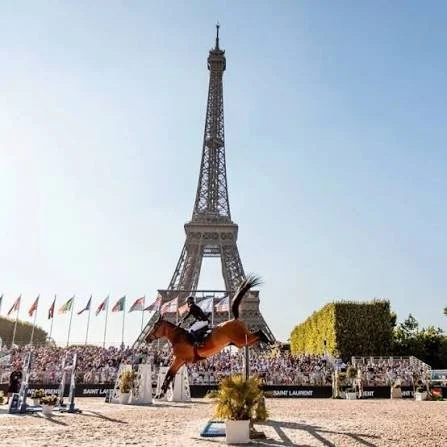
The Enduring Value of Equestrian Sport
Horsemanship's Enduring Role in Shaping Character, Leadership, and Community Across Generations
A McWhorter Foundation reflection on equestrian sport, horsemanship, show jumping, social capital, leadership development, economic impact, heritage preservation, and the role of horses in shaping future generations.
Few sports have remained relevant across as many centuries as equestrian sport.
Empires rose and fell upon horseback.
Agriculture depended upon it.
Exploration expanded because of it.
Military leadership was often inseparable from it.
Long before horses became associated with competition, they were among humanity's most trusted partners in work, transportation, and civilization itself.
Today, while technology has transformed the modern world, the relationship between horse and rider continues to preserve lessons that remain remarkably relevant.
For this reason, the McWhorter Foundation views horsemanship not merely as a sport, but as a living inheritance worthy of preservation.
The Discipline of Partnership
Most athletic pursuits focus on the development of individual performance.
Equestrian sport is fundamentally different.
Success depends upon communication between two living beings.
The horse cannot be controlled through force alone.
Instead, progress requires patience, consistency, trust, awareness, and emotional discipline.
Research in equine-assisted learning and leadership development has increasingly highlighted the importance of emotional regulation, nonverbal communication, and trust-building skills that emerge through horse-human interaction. Studies published by organizations including the Fédération Equestre Internationale (FEI) and academic researchers in equine behavior have noted that effective horsemanship requires riders to develop self-awareness and adaptability rather than reliance on force or intimidation.
The rider quickly discovers that frustration weakens performance while composure strengthens it.
These lessons extend well beyond the arena.
The same qualities required to guide a horse effectively often emerge in leadership, business, philanthropy, diplomacy, and family life.
Modern competition continues to showcase these principles on a global stage. The FEI calendar for 2026 includes major international championships and Nations Cup competitions across Europe, North America, the Middle East, and Asia, bringing together riders, horses, trainers, veterinarians, and support teams from dozens of countries. These events demonstrate that while equestrian sport has deep historical roots, it remains a vibrant and evolving part of contemporary athletic culture.
The Development of Posture and Presence
Horsemanship has historically been associated with confidence, bearing, and personal presence.
There are practical reasons for this.
Riding develops balance, coordination, posture, body awareness, and core strength.
A rider's position directly influences the movement and confidence of the horse beneath them.
Over time, good riders learn to project calm authority rather than force.
They learn to lead through consistency rather than volume.
In many respects, horsemanship continues to be one of the few disciplines that simultaneously develops physical control, emotional regulation, and personal presence not simply because observers say so, but because generations of riders, trainers, competitors, and horsemen have lived these lessons firsthand.
The Social Value of Equestrian Culture
Unlike many modern sports, equestrian culture remains deeply intergenerational.
Young riders routinely learn from experienced professionals.
Families participate together.
Mentorship remains central.
Relationships are often measured in decades rather than seasons.
As a result, equestrian communities continue to foster forms of social capital that are increasingly rare in modern society.
Reputation matters.
Stewardship matters.
Trust matters.
The sport rewards patience over spectacle and character over noise.
The Economics Behind the Tradition
Equestrian sport is frequently misunderstood as a niche activity.
In reality, the broader horse industry represents one of the world's largest sporting and agricultural ecosystems.
Industry studies estimate that the global equine sector generates approximately $300 billion in annual economic activity while supporting extensive networks of employment across breeding, training, veterinary medicine, land management, transportation, tourism, hospitality, manufacturing, and competition. The industry contributes roughly $74 billion directly to U.S. GDP and supports millions of jobs across rural and urban communities, from family-owned stables to international sporting organizations. These economic networks help sustain knowledge, traditions, and opportunities that have been passed from one generation to the next.