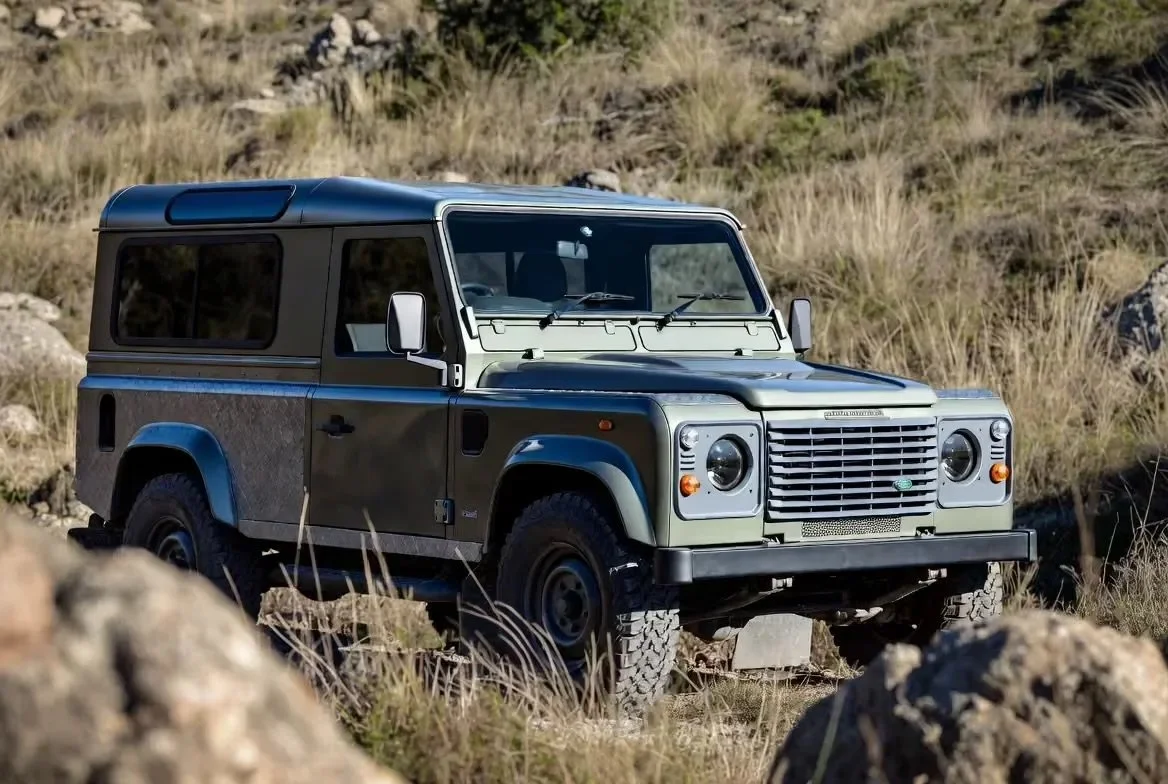
The McWhorter Family Defender Adventure, Design & Generational Stewardship
The McWhorter Family Defender
Adventure, Design & Generational Stewardship
There are certain objects that become more meaningful with time.
A family home. A piece of art. A watch passed from father to son. A library assembled over decades. A photograph taken on a journey that becomes part of the family’s permanent archive.
And then there are objects designed to move.
For the McWhorter Family, the Land Rover Defender represents something more than transportation. It represents adventure, British design, family life and the stewardship of an object that can accompany generations of memories.
Imagine it on a cool Scottish morning, parked before a historic château or country estate. The landscape is green and expansive. The Defender’s silhouette stands against centuries of architecture. Along the side of the vehicle is not merely a manufacturer’s badge, but the McWhorter family crest a contemporary expression of family identity carried into the world.
That is the idea behind The McWhorter Family Discovery.
A Vehicle Born From Adventure
The Defender’s story begins in 1947, when Maurice Wilks famously sketched the outline of a new utility vehicle in the sand at Red Wharf Bay on the Welsh island of Anglesey. The resulting Land Rover became one of the world’s defining four-wheel-drive vehicles.
Its history is unusually connected to exploration, work, conservation and the British landscape. Land Rover records that the vehicle was being used by British royalty within its first years, while later expeditions demonstrated its ability to travel enormous distances across difficult terrain. The Oxford and Cambridge Far Eastern Expedition, for example, covered approximately 18,000 miles from London to Singapore in 1955–56. (landrover)
That history matters.
The Defender was never designed merely to look adventurous. Adventure was part of its original purpose.
Today, the modern Defender carries that philosophy into a very different era. The Defender 110 can accommodate up to seven occupants, offers substantial cargo capacity, and is engineered for both everyday roads and demanding terrain. Land Rover lists a maximum wading depth of up to 900mm and towing capability of up to 3,500kg on applicable configurations. (landrover)
For a family, that combination is compelling.
It can take children to school, carry luggage to the airport, transport equipment for an equestrian weekend, travel to a country estate, tow a trailer or horsebox, and then leave the pavement entirely for a family expedition.
The same object can be practical on Monday and adventurous on Saturday.
Why the Defender Works as a Family Asset
A family asset does not necessarily have to mean an asset that appreciates every year.
Some of the most important family possessions derive their value from utility, durability, identity and memory.
The Defender possesses all four.
It is useful because it is designed to carry people and equipment. It is durable because durability has always been central to the Defender’s engineering philosophy. It has identity because its shape is immediately recognizable. And it creates memories because it is fundamentally a vehicle for going somewhere.
Land Rover itself describes the Defender as having durability at its core and emphasizes its ability to operate both on and off road. The 110’s seven seat configuration also makes it particularly relevant to family use. (landrover)
That makes the Defender particularly interesting as a generational object.
A family may purchase it for one generation’s adventures, maintain it carefully, and eventually hand it to another generation.
The children who once occupied the rear seats may someday become the parents driving their own children.
The vehicle becomes the common thread.
The Collector’s Market Tells Another Story
There is also a fascinating collector dimension to the Defender.
Exceptional examples have demonstrated that the market is willing to place substantial values on the right combination of provenance, specification, rarity, condition and craftsmanship.
As of 2026, Classic.com records the highest reported sale for a Land Rover Defender at $410,000, for a 2015 Defender 90 Wagon sold June 7, 2026. Classic.com reports an overall average Defender sale price of approximately $53,000, illustrating the enormous difference between an ordinary example and an exceptional one. (Classic.com)
The distinction is important.
The $410,000 result should not be interpreted to mean that every Defender is a $400,000 collectible. It demonstrates something more interesting: the Defender has developed a serious enthusiast and collector market in which extraordinary examples can command extraordinary prices.
The UK market provides another useful reference point. Verified UK Defender 110 sales tracked by Marque show a highest recorded sale of £136,000 for a 2016 Defender 110 Works V8 70th Edition with only 6,073 miles. Collecting Cars also documented that £136,000 sale. (Marque)
That particular example is instructive because it combines several characteristics that collectors tend to appreciate:
limited production, special specification, low mileage, provenance and historical significance.
It is a reminder that scarcity and story can matter enormously.
From Automobile to Family Artifact
This is where the McWhorter Family concept becomes different.
The objective would not simply be to own a nice Defender.
The objective would be to create a McWhorter Defender.
A carefully selected Defender could be finished in a restrained, timeless specification perhaps a deep green, muted grey, or another color appropriate to the family’s aesthetic. The interior could favor durable natural materials and understated detailing rather than excessive customization.
And on the side could be the McWhorter family crest.
Not oversized.
Not ostentatious.
Simply present.
The crest would transform the vehicle from a generic luxury SUV into something connected to a particular family story.
It would become recognizable without needing to announce itself.
A Defender Before a Scottish Estate
There is something especially appropriate about placing the vehicle within the landscape from which its cultural identity emerged.
Picture a Defender 110 outside a historic Scottish or English country estate.
Stone walls.
Ancient trees.
Mist over the hills.
An equestrian field in the distance.
The McWhorter crest on the door.
It would be an interesting juxtaposition: an object of modern British engineering positioned against centuries of European architectural heritage.
The Defender belongs naturally in that setting because its identity has always been connected to the British countryside.
Land Rover’s own heritage materials emphasize its relationship with the British landscape, British royalty, expeditions and conservation. The company also continues to develop heritage-inspired Defenders, including the limited-production Works V8 Islay Edition, which was limited to just 30 examples and drew inspiration from a 1965 Land Rover Series IIa associated with Land Rover founder Spencer Wilks and the Hebridean island of Islay. (landrover)
That is precisely the kind of relationship between place, object and history that makes an automobile interesting to a family archive.
The McWhorter Standard: Buy for Today, Preserve for Tomorrow
There is a principle worth adopting when considering objects for a family collection:
Buy something because you love its purpose today, and preserve it because it may tell a story tomorrow.
A Defender fits that philosophy unusually well.
It does not have to sit behind velvet ropes.
In fact, it should not.
It should be driven.
It should travel.
It should carry children, luggage, dogs, picnic baskets, sporting equipment and family photographs.
It should see cities and countryside.
It should cross borders.
It should become associated with birthdays, holidays, school years, summers, Christmases and family journeys.
That is how an object becomes important.
Not because it was expensive.
Because it was there.
Stewardship Over Speculation
The McWhorter Family approach to the Defender would therefore be one of stewardship rather than speculation.
A future collector’s value may be enhanced by low mileage, originality, rarity, documented provenance and careful maintenance. But a family should not sacrifice the purpose of the vehicle merely in pursuit of future appreciation.
The better approach is to purchase an exceptional example, document its history, maintain it properly, retain important records, photograph significant journeys and preserve the story of its ownership.
If the vehicle becomes more valuable over time, that is an added benefit.
If it becomes a cherished family artifact, the greater value may be something that cannot be measured on an auction sheet.
A Family Crest in Motion
The McWhorter crest on a Defender would therefore represent more than decoration.
It would symbolize continuity.
The crest belongs to the family.
The Defender belongs to the road.
Together they create a moving expression of the family’s philosophy:
heritage without being trapped by the past;
luxury without excess;
adventure without recklessness;
design with purpose;
and possessions understood as things to be stewarded rather than simply consumed.
The family vehicle becomes part of the family archive.
One day, photographs of the Defender may sit beside photographs of family homes, travels, works of art, equestrian experiences and important family occasions.
Perhaps the children will remember it as the family Defender.
Perhaps decades later, one of them will still recognize the crest immediately.
And perhaps, long after its first journey, another generation will open the door, see the McWhorter crest and understand that they are not simply entering an automobile.
They are entering part of their family’s story.
The McWhorter Family Discovery
The Defender is ultimately an expression of an idea that extends beyond automobiles.
Discovery.
Discovery of landscapes.
Discovery of cultures.
Discovery of family.
Discovery of history.
Discovery of what lies beyond the familiar.
For the McWhorter Family, the ideal Defender is therefore not merely a vehicle to possess.
It is a vehicle to use, preserve, personalize and eventually remember.
Parked before a Scottish château, traveling through the countryside, carrying a family toward its next destination, or sitting quietly in the family archive years from now, the Defender can represent something remarkably simple:
Where we came from matters.
Where we are going matters.
And the journey between the two belongs to us.
Market Perspective
Selected documented Defender values illustrate the strength of the model’s collector appeal:
$410,000 — highest recorded Land Rover Defender sale reported by Classic.com, a 2015 Defender 90 Wagon, June 7, 2026. (Classic.com)
£136,000 — 2016 Defender 110 Works V8 70th Edition, 6,073 miles, sold through Collecting Cars in May 2025. (Marque)
£67,500 — a Defender 90 formerly used by King Charles sold at auction, with royal provenance contributing to the result. (The Scottish Sun)
$294,800 — a highly modified 1988 Defender 110 6x6 sold at Barrett-Jackson’s 2023 Scottsdale auction. (YouTube)
These results should be viewed as examples of exceptional-market outcomes, not as a prediction of future appreciation for any particular Defender.